skip to main |
skip to sidebar
Well, since it was a really icky cold day, I decided that there wouldn't be many fisherman at the boat ramp and maybe some birds would show up!! There were very few but with the binoculars I saw that there were a lot out on the stone wall. It was a very high tide again and most of the wall was under water but I headed out as far as I could (never did get far enough to see all the birds that I had spotted but was rewarded nonetheless.) There was a large flock of Dunlins digging around on the Cape Fear River beach. It is very brackish down this close to the ocean.
Way out I could see that there were quite a few Marbled Godwits but this one fellow was on the beach with the Oystercatchers and Dunlins. It provided a nicer background for pictures than usual.
You can see how much bigger the Marbled Godwit is than the Dunlins in this picture. It was windy enough that there were actually waves breaking and some foam which looked like snow (it wasn't).
I think this is my favorite picture ever of one of the Oystercatchers! I can see he was banded as well in this pic. There were several down there but he was the only one awake. Of course some more people came and they all flew away! You don't usually get to see the bills all nice and sparkly clean as they are usually digging energetically in the muddy shore by the ramp.
Heading back to the ramp, there was still one Red Breasted Merganser present who was diving like crazy -- you can even see his red foot in this pic.
Two Ruddy Turnstones were pecking at the dock -- not turning stones like usual! I saw some the day before as well in with the Dowitchers.
Last and least a juvenile Herring Gull. Have seen a lot of these big birds lately. There are also a ton of Laughing Gulls and Ring-billed Gulls trying to get hit by the car as you drive through!
My sister and her husband headed back to Florida via the ferry at Ft. Fisher. Of course they took the time to go to the boat ramp to see if there were any birds even though it was high tide (and a very high tide at that). Imagine their surprise to finally see all the birds I had been talking about!! Crowded in this picture are a flock of Forster's Terns, several Willets, a Marbled Godwit and several Short-billed Dowitchers. She called me from the ferry to tell me she had seen just tons of birds so I headed straight down!
The Dowitchers and several other birds were all crowded on the rocks by the boat ramp. I stayed in the car (using it as a blind) so I could get pictures of as many birds as possible so I could identify them when I got home. Most were asleep when I arrived but all flew off when a fisherman came by but did come back and roost and were awake!! The rocks were completely covered as they were one other morning when I spotted them.
There were also two Marbled Godwits in the midst of the Dowitchers.
There were also Horned Grebes up close and keeping above the water for picture taking -- they tend to dive a lot in a whole flock usually!
A closeup of one of the Grebes.
A closeup of one of the Forster's Terns -- about the most common one down here but usually seen diving for food from high in the sky.
I may be mistaken but I think there is a Red Knot in the bunch here! It is the one with the much shorter black bill. They have slightly darker greenish legs as well but are about the same size as the Dowitchers.
There were also two Red Breasted Mergansers swimming around. This was a life bird for Gail so we succeeded again as last time she added a Long Tailed Duck to her list. Too bad the White Winged Scoters didn't show up this time.
Eventually a fishing boat came to use the ramp and all the birds flew off -- most are Dowitchers but you can see a Willet or two in the bunch. If you look closely you can spot the white patches on the back of the Dowitchers.
We weren't totally successful at providing nice weather for our "fair weather" Florida relatives this past weekend! My sister and her hubby came up for a short visit and we tried to provide some birding for them and managed a little before they left. Fortunately (or unfortunately) the weather deteriorated but the birding improved just as they left!! Our first day we went to the Basin trail to see the Hooded Mergansers and down to Carolina Beach State Park.. We also made frequent visits to the boat ramp at Ft. Fisher as you just never know.... The second day we took them to Greenfield Lake and the Arboretum but both were free of birds for the most part. This scene is of some of the swampy part of Greenfield Lake and one of my favorite scenes with the cypress and the algae. The alligators like it over here but it was far too cold for any alligators!

The Hooded Mergansers were showing off their fine feathers and were doing all sorts of dancing behaviors and Bill and I watched for some time.
There were also some Ruddy Ducks mostly sleeping and a female Hooded Merganser in the foreground. No diving today!!
There were a lot of Horned Grebes down by the boat ramp.
We spotted this juvenile Cooper's Hawk sitting in a tree at Carolina Beach State Park.
Sunday morning brought extra icky cold windy weather which is perfect for sighting Northern Gannets from the porch!! Gail was the first to see them! They are a beautiful very large elegant bird which usually spends its time out over the ocean except for these stormy days when you see lots of them.
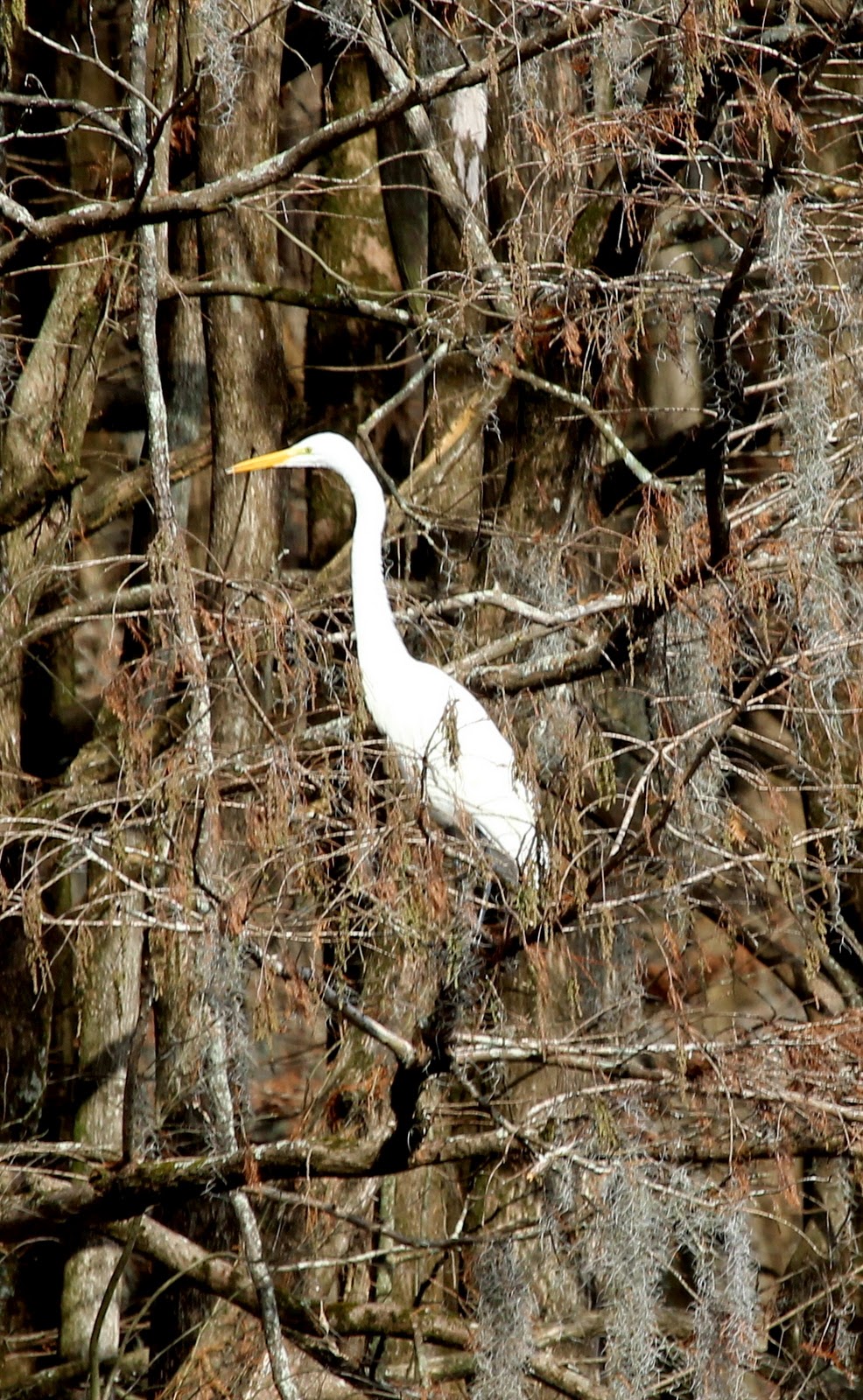
All we saw at Greenfield Lake were a Pied Billed Grebe and another Ruddy Duck. There was an area which was just filled with Great Egrets which only I got out in the cold and photographed!! I liked the background of the trees.
This is my sister Gail and her husband Bill in front of the most beautiful Japanese maple (which doesn't show unfortunately) at the Arboretum.
The Camellias were blooming and this is a nice pansy garden for all my northern friends!! It is cold but we have flowers here all year round!!
Tomorrow pictures of all the birds that came down to the boat ramp on the morning that they left (but fortunately which they were able to see on their way to the ferry and going home).
Not a lot of pictures with this blog as I managed to leave my camera at home!
However, Dianne decided she wanted to do one of my "extreme overdyeing" sessions (Extreme Overdyeing Technique). We decided to do 1/2 yard pieces of fabric for each color.
The technique uses 10 dye pots to achieve 35 different colors. You start with six pieces of whatever size you want in each of the pots, all with numbers A-0 through E-5 and an additional 01 -05. First time around you put all the A's in one color, all the B's etc. The second time you sort them by number and place in the colors leaving out the 0s from the first batch.
We used for the rows here, Dharma Wisteria (very very light lavender), Dharma Chinese Red (an orangey red), ProChem Mixing Red (a bluish red), ProChem Strong Orange (very strong orange and a pure color) and ProChem Sun Yellow (a nice bright yellow). The columns were ProChem Basic Brown, ProChem New Black, ProChem Intense Blue, ProChem Deep Navy (pure color) and Dharma Turquoise. I didn't have a scale and kept very poor track of how much was dumped into each pot but tried to approximate a tbsp for 5 1/2 yards of fabric which is roughly a 3% solution but I was VERY inacccurate! In my bunch you can see one very un-pfd fabric the second from the right on the bottom row which should have been a nice deep green -- really obvious here!!
Unlike my usual process of putting the fabric in the pots dry, we wet them first so that we would get more patterning and color separation as water acts somewhat as a resist. You can get even more patterning by soaking the fabric in soda ash first as well.
Getting ready for a visit from my sister and her husband!! Should be fun and hopefully they won't be too grossed out by the house!!
Show and Tell is always the best part of the meeting! I loved this kitty quilt. All the fabrics that make up the kitties are kitty fabrics as well!
Two of the quilts that are made for Habitat for Humanity. This Guild does so much for the different charities they support.
Another of the Habitat quilts.
These are fabrics that were dyed in my class in September. She was very pleased with the results and will use the bright ones for a quilt.
I loved this beautiful jacket. Very organic.
The front of the jacket!
This is a quilt from a former cross-stitcher. She incorporated one of her older cross-stitched panels in the middle. Loved the colors and the design.
This was a fun pumpkin quilt!
I think Miranda did a wonderful job of incorporating some blocks she did years ago into a very pleasing composition. Loved the way she used the reds.
I always love a good scrap quilt and really liked this one begun in an Augusta Cole class. The Guild has sponsored her classes a number of times as she always has fun scrap quilts.
No November meeting would be complete without at least one Christmas-y quilt! This was a very fun one with a scrappy look!
After a wonderful stay at our wilderness accommodations, we rose at 4:30 in the morning to grab a quick bite and some coffee and head out in the pitch dark to try to spot some bears at the Pocosin National Wildlife Refuge, home to 11,000 Black Bears!! There had been reports that people saw quite a few the day before, but no guarantees were made as it was a very cool morning. While waiting for some bears to appear (we had to stay very close to the bus as the bears can run up to 35 mph). We spotted many flocks of Tundra Swans (seen above) and Snow Geese flying overhead. The refuge is home to 75% of the world population of Tundra Swans in the winter and the noise carries for a long way!!
We didn't have to wait but for a few minutes at our first site to spot a bear heading for the pocosin! You can see the sun is just coming up. The bears hang out in the cornfields on the left side of the road but head to the pocosin when nervous about people! According to Wikipedia,
"Pocosin is a term for a type of palustrine wetland[1] with deep, acidic, sandy, peat soils. Groundwater saturates the soil except during brief seasonal dry spells and during prolonged droughts. Pocosin soils are nutrient deficient (oligotrophic), especially in phosphorus."
Still early we spot another bear along the edge of the cornfield.
And then we spot the Mama Bear and three cubs. One cub is in the foreground and the Mama is the middle bear in the background. What a treat. Altogether we saw 22 different bears, many really off in a distance as they are wary of people which is a good thing. We made so many sightings, that we lost count!! This was all in a relatively short period of time although the temps were probably in the high 20s for the first part. We spotted bear skat which showed all the corn they had been eating!!
We also saw lots of bear tracks, raccoon tracks and the tracks of the Red Wolf, an endangered species that has been re-introduced in this area.
In addition to the flocks of Tundra Swans, we saw huge flocks of Snow Geese flying overhead. The have the shorter necks and the black wing tips. They fly in a very disorganized manner as opposed to the Tundra Swans that form the classic vee shape we see in Canada Geese.
This is what those flocks of Snow Geese look like. When the Snow Geese have all arrived (close to an estimated 70,000), they will lift off the lakes in one flock filling the sky and looking like snow, Some of my fellow travelers had seen this and remarked that it sounded like a train coming as well as obliterating the sky completely. They will not all arrive until later -- especially after Maryland has had some cold weather or snow.
A closeup of one of the Tundra Swans which were flying overhead in large flocks as well.
The Tundra Swans are so big, they huff and puff to take off even from the water and make an incredible flapping noise in additional to their constant calls.
I am so used to seeing Red-winged Blackbirds sitting on stalks in the marsh, it was surprising to see a very large flock fly overhead. Evidently during the height of winter, they number in the tens of thousands as well!!
One of the coolest sights of the day was this tableau! There were three juvenile Bald Eagles (two pictured here) and an adult Bald Eagle. One of the juveniles had scored a snake and was taking it away when the adult decided he wanted it. If you look closely in the bottom left of the above picture, you can see the snake dropping through the air. The adult snatched it.
You can see the adult has the snake here!!
You can see that there are some other hawks in the background of the picture.
We lost count of the number of Bald Eagles we saw over the two days. They were probably the most commonly sighted hawk!!
We did see quite a number of Northern Harriers as well.
Another treat was seeing a flock of Wood Ducks flying overhead.
You couldn't see all their colors though.
I looked in the ditch and saw something swimming and it was identified for me as a Nutria which is like a giant ratty muskrat. They are an intruder from South America brought north during the days of the fur trade (I guess they made coats out of them).
Here is a closeup of the Nutria with his huge orange teeth. You can even see the little paw which is holding vegetation which he is eating.
What a surprise to see a whole grouping of Wilson's Snipes. There are five in this shot and there were a couple of more on the side. Since there were so many Snipe, they were relatively easy to spot. They blend in so well with their environment that when standing alone, they are really difficult to see. Bitterns are the same way. These Snipe were mixed in with Yellowlegs (I think both Lesser and Greater) and Dowitchers and some Dunlin.
This is a closeup of a Wilson's Snipe.
Have to do some guessing here but think there is a Lesser Yellowlegs and some Long-billed Dowitchers.
This trip really exceeded my expectations and I will definitely sign up for the one that is a bit longer in January!!




 Posts


